
PP Honeycomb Plate Extrusion Line
Introduction
Welcome to Kriimpas India Pvt. Ltd., where we offer comprehensive solutions for all your material processing needs. Since 2012, we have been dedicated to providing top-notch machinery and services to our valued customers.
In today’s packaging and manufacturing industries, businesses are looking for materials that are lightweight, strong, durable, and cost-effective. PP honeycomb plates have become a popular choice because they offer a good combination of strength, low weight, and flexibility. These plates are widely used in packaging, automotive components, construction, furniture, advertising, and many other industries. To manufacture these plates efficiently, businesses need a reliable PP Honeycomb Plate Extrusion Line.
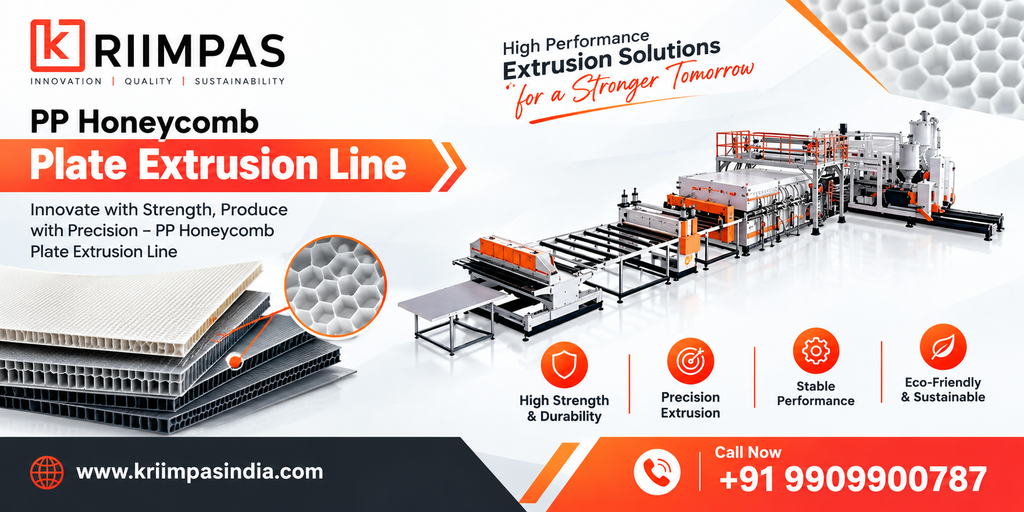
A PP honeycomb plate extrusion line is a specialised machine system used to produce polypropylene honeycomb sheets and plates. These sheets have a honeycomb-like internal structure that helps provide strength while reducing material weight. The extrusion line processes polypropylene (PP) material and converts it into plates with the required thickness, width, and surface finish.
Kriimpas India Pvt. Ltd. supports industrial businesses by providing machinery solutions for modern plastic processing requirements. For companies planning to manufacture PP honeycomb plates, selecting suitable extrusion equipment is an important step towards improving production efficiency, maintaining product quality, and meeting customer demands. We are the best PP Honeycomb Plate Extrusion Line Manufacturer.
What Is a PP Honeycomb Plate Extrusion Line
A PP Honeycomb Plate Extrusion Line is a production system used to manufacture polypropylene honeycomb plates. PP stands for polypropylene, a thermoplastic material known for its low weight, chemical resistance, and good mechanical properties. The extrusion line generally includes a feeding system, extruder, die, forming or calibration section, cooling system, haul-off unit, and cutting equipment. Each component performs a specific function in the production process. We are the best PP Honeycomb Plate Extrusion Line Supplier.
The extrusion line melts polypropylene material and processes it through specially designed equipment to produce sheets with a honeycomb structure. Depending on the machine design, the final product can be manufactured in different thicknesses, widths, and surface finishes. These plates are useful for applications where manufacturers need strong but lightweight materials. Compared with some solid plastic sheets, honeycomb plates can reduce weight and material consumption while providing useful stiffness.
How Does a PP Honeycomb Plate Extrusion Line Work
1. Raw Material Feeding
The process begins with polypropylene granules being supplied to the feeding system. Depending on the product requirements, suitable additives, colour masterbatch, or approved recycled material may also be used. The quality and consistency of the raw material influence the final plate’s performance.
2. Melting and Extrusion
The polypropylene granules enter the extruder, where controlled heat and screw movement melt and mix the material. The molten plastic is then pushed towards the die system. Temperature, screw speed, and material flow must be properly controlled to achieve stable extrusion and consistent output.
3. Honeycomb Structure Formation
The specialized forming system creates the required honeycomb structure. Depending on the machine design, this may involve dedicated dies, forming equipment, or other structural shaping methods. The design of the internal cells is important because it affects the plate’s weight, stiffness, and suitability for different applications.
4. Cooling and Calibration
After forming, the plate passes through cooling and calibration equipment. This stage helps maintain the required dimensions and improves the stability of the finished sheet. Proper cooling reduces the risk of unwanted deformation and helps maintain uniform thickness.
5. Haul-Off and Cutting
A haul-off unit moves the sheet through the production line at a controlled speed. The cutting system then cuts the finished plates into the required lengths. Depending on the machine configuration, additional finishing, stacking, or handling equipment can be included to support efficient production.
Applications of PP Honeycomb Plates
1. Packaging Industry
PP honeycomb plates are used to manufacture reusable packaging boxes, protective packaging sheets, transit boxes, and industrial containers. Their lightweight structure helps reduce transportation weight while protecting products during storage and shipping.
2. Automotive Industry
These sheets are used in automotive interior panels, door panels, trunk liners, boot floors, and lightweight vehicle components. Their strength-to-weight ratio makes them suitable for applications where reducing vehicle weight is important.
3. Construction Industry
PP honeycomb plates are used for temporary partitions, protective boards, wall panels, and lightweight construction panels. They are easy to cut, handle, and install for suitable indoor and temporary applications.
4. Furniture Manufacturing
Manufacturers use PP honeycomb sheets in lightweight furniture panels, cabinet components, table panels, shelves, and partitions. They can help reduce the overall weight of furniture while maintaining useful structural stiffness.
5. Advertising and Display
These plates are suitable for promotional displays, exhibition boards, signage backing, retail display panels, and advertising structures. Their smooth surfaces can support printing, lamination, and other finishing processes, depending on the sheet grade.
6. Industrial Applications
PP honeycomb sheets are used for machine covers, protective panels, equipment enclosures, storage dividers, and industrial packaging. Their chemical resistance and low weight make them useful for various industrial environments.
7. Agriculture Industry
These sheets can be used for reusable produce boxes, agricultural product packaging, protective dividers, and storage containers. Their suitability for outdoor use depends on the material grade and whether UV protection is required.
8. Logistics and Warehousing
PP honeycomb plates are used to manufacture reusable storage bins, separator sheets, pallet layers, and warehouse partition systems. Their lightweight construction can make handling and movement easier.
9. Electrical and Electronics Packaging
The sheets are used for component separators, protective packaging, electronic product transit boxes, and equipment packaging. They help separate products and reduce the risk of scratches or impact damage during transportation.
10. Marine and Transportation Applications
Suitable PP honeycomb panels can be used in lightweight interior panels, transport partitions, and selected marine fit-out applications. The material grade, panel design, bonding method, and environmental conditions should be considered before use.
Benefits of PP Honeycomb Plate Extrusion Line
1. Lightweight and Strong Sheet Production
One of the biggest benefits of a PP Honeycomb Plate Extrusion Line is its ability to produce sheets that combine low weight with good structural strength. The honeycomb structure helps distribute loads while reducing the amount of material required. These lightweight sheets are suitable for applications where easy handling, durability, and reduced product weight are important.
2. High Production Efficiency
A modern PP Honeycomb Plate Extrusion Line is designed to support continuous manufacturing. It combines material feeding, melting, extrusion, sheet forming, cooling, and cutting into an integrated production process. This helps manufacturers maintain a steady output, reduce manual handling, and improve overall productivity when the machine is correctly configured and maintained.
3. Cost-Effective Manufacturing
PP honeycomb sheets can offer material savings because their structured core provides stiffness without requiring a completely solid sheet. Efficient processing can also help reduce production waste and improve material utilization. The overall cost advantage depends on the raw material price, sheet thickness, production speed, energy consumption, and machine configuration.
4. Excellent Durability
Polypropylene honeycomb plates are designed for applications that require a combination of strength and low weight. They can provide good resistance to moisture and many common chemicals, depending on the polypropylene grade and operating conditions. This makes them useful for reusable packaging, protective panels, industrial partitions, and other products that need dependable service life.
5. Wide Range of Applications
A PP Honeycomb Plate Extrusion Line can produce sheets for several industries. With suitable tooling and process settings, manufacturers can customize sheet thickness, width, surface finish, and core structure to meet different requirements. The actual savings depend on sheet thickness, core design, density, material grade, and required performance.
6. Customization and Product Flexibility
The machine can be configured to manufacture PP honeycomb plates in different sizes, thicknesses, colors, and surface finishes. Depending on the equipment design, manufacturers may also produce multi-layer boards and add fabric or decorative film lamination. This flexibility allows businesses to serve customers across different industries without being limited to a single product type.
7. Moisture and Chemical Resistance
Polypropylene is naturally resistant to moisture and many common chemicals. Therefore, PP honeycomb plates can be suitable for damp environments, reusable packaging, and industrial applications where ordinary paper-based materials may not perform well. The exact resistance depends on the chemical, temperature, and quality of the finished sheet.
8. Easy Handling and Installation
Due to their low weight, PP honeycomb plates are generally easier to transport, cut, handle, and install than many heavier solid materials. This can reduce handling effort during manufacturing, packaging, and assembly. For businesses producing large panels, easy handling can also simplify storage and movement within the facility.
9. Improved Material Utilization
The honeycomb core uses a structured design to achieve stiffness with less material than a solid plate of comparable dimensions. With suitable process control and scrap management, the extrusion line can help manufacturers improve raw material utilization and reduce avoidable waste. Recycling production scrap depends on its cleanliness, material composition, and the quality requirements of the final product.
10. Reusable and Recyclable Material
PP honeycomb plates can be designed for repeated use in suitable packaging and industrial applications. Their durability and moisture resistance can help make reusable containers and protective boards practical alternatives to some disposable materials. Polypropylene is also recyclable where suitable collection and processing facilities are available. Actual recyclability depends on additives, coatings, laminations, and contamination.
11. Consistent Product Quality
A properly designed extrusion line helps maintain uniform sheet thickness, surface quality, and honeycomb cell formation. Consistent manufacturing is important for customers who need plates with predictable dimensions and performance. Regular maintenance, accurate temperature control, and suitable raw material selection help manufacturers maintain production quality.
How to Choose the Right PP Honeycomb Plate Extrusion Line
Selecting the right machine is an important decision for any plastic manufacturing business. Buyers should consider several factors before making an investment.
Production capacity: Identify the required output per hour or per day. Compare the machine’s rated capacity with realistic production requirements.
Plate dimensions: Confirm the maximum and minimum sheet width, thickness, and cutting length supported by the equipment.
Raw material compatibility: Check which grades of polypropylene and other approved materials can be processed.
Product structure: Explain whether you require a particular honeycomb geometry, density, stiffness, or surface finish.
Energy consumption: Ask for details about installed power and expected energy use under specified operating conditions.
Automation level: Review the control system, operator requirements, cutting arrangement, and production monitoring features.
Maintenance and spare parts: Check the availability of replacement components, technical assistance, and maintenance instructions.
After-sales support: Reliable installation guidance, operator training, and technical service can help reduce production interruptions.
Discussing these requirements with the machinery supplier helps ensure that the selected line matches your business needs.
Why Choose Kriimpas India Pvt. Ltd
1. High Production Efficiency
A PP Honeycomb Plate Extrusion Line is designed to support continuous production and help manufacturers produce sheets efficiently. Depending on the machine configuration, automation level, and production requirements, the line can reduce manual work and improve manufacturing output.
A well-designed extrusion system supports smooth material feeding, melting, extrusion, sheet forming, cooling, and cutting. This organised process helps manufacturers manage large orders and maintain a consistent production schedule.
2. Lightweight and Strong Sheet Production
One of the main reasons to choose a PP Honeycomb Plate Extrusion Line is its ability to manufacture lightweight sheets with a honeycomb core structure. This structure provides strength and stiffness without requiring excessive material.
Lightweight sheets are useful for applications where reducing product weight is important. They can help manufacturers develop packaging products, protective panels, automotive interior components, and industrial partitions that are easier to handle and transport.
3. Excellent Material Utilisation
Polypropylene is a versatile thermoplastic material that can be processed into various sheet products. A properly configured extrusion line helps manufacturers control material feeding and processing conditions to achieve efficient material utilisation.
Depending on the product design and process setup, manufacturers may also be able to use suitable recycled polypropylene. However, the material must meet the required quality and performance standards to ensure consistent sheet production.
Better material management can help reduce unnecessary waste and improve overall manufacturing economics.
4. Consistent Product Quality
Product quality is essential for manufacturers serving packaging, construction, automotive, and other industrial sectors. A reliable PP Honeycomb Plate Extrusion Line helps maintain uniform sheet thickness, surface finish, and structural consistency.
Important machine components, including the extrusion system, die, calibration unit, cooling system, and haul-off mechanism, work together to produce sheets according to the required specifications.
Consistent quality makes it easier for manufacturers to supply products that meet customer expectations and application requirements.
5. Cost-Effective Manufacturing
Investing in a PP Honeycomb Plate Extrusion Line can help businesses manage production costs over the long term. Efficient processing, suitable automation, and proper material utilisation may reduce labour requirements, material losses, and production interruptions. The honeycomb structure also allows manufacturers to produce lightweight panels with useful stiffness while controlling material consumption.
For businesses planning to enter the plastic sheet manufacturing industry or expand an existing production facility, this technology can offer a practical manufacturing solution. Actual cost savings depend on machine capacity, energy consumption, raw material prices, maintenance, and production volume.
6. Customisable Sheet Thickness and Dimensions
Different industries require PP honeycomb plates in different sizes and specifications. A suitable extrusion line can be configured to produce a range of sheet thicknesses, widths, and structural designs within its operating limits.
Manufacturers can select the appropriate machine configuration according to their target market and product requirements. Die design, calibration, cooling, and cutting systems all influence the dimensions and quality of the finished sheets.
This flexibility helps businesses respond to changing customer requirements and develop products for specialised applications.
7. Improved Automation and Operational Control
Modern PP Honeycomb Plate Extrusion Lines may include automated temperature controls, motor drives, material-feeding systems, thickness adjustments, and production monitoring features.
These systems help operators maintain stable processing conditions and reduce the need for continuous manual adjustments. Depending on the selected configuration, automation can also support faster product changeovers and more repeatable production.
Proper operator training and regular monitoring remain important for achieving reliable performance.
8. Reduced Product Weight and Easier Handling
PP honeycomb plates are valued for their lightweight structure. Compared with certain solid plastic panels of similar dimensions, appropriately designed honeycomb sheets can reduce weight while providing useful rigidity.
Lower product weight can make handling, installation, storage, and transportation easier. For reusable packaging and material-handling applications, this can be a valuable advantage. However, manufacturers should evaluate load capacity, impact resistance, and durability before selecting a sheet for a specific application.
9. Durable and Moisture-Resistant Material
Polypropylene naturally offers good moisture resistance and chemical resistance to many common substances. These properties make PP honeycomb sheets suitable for several indoor and industrial environments.
The sheets can be useful for reusable packaging, protective boards, and applications where exposure to moisture is a concern. Their actual durability depends on the grade of polypropylene, additives, sheet design, operating temperature, and exposure conditions.
9. Automation and Process Control
Modern extrusion lines may include automated feeding, temperature monitoring, extrusion controls, calibration systems, cooling arrangements, and cutting equipment. The availability of these features depends on the machine model and configuration.
Automation can help operators maintain stable production parameters, improve repeatability, and reduce certain manual tasks. However, the benefits depend on proper installation, operator skills, preventive maintenance, and suitable raw material quality.
Frequently Asked Questions (FAQs)
1. What is a PP Honeycomb Plate Extrusion Line
It is a specialised production system used to manufacture polypropylene plates with a honeycomb structure for lightweight and industrial applications.
2. Which material is used in PP honeycomb plate production
Polypropylene is the primary material. The appropriate grade depends on the required strength, flexibility, surface quality, and intended application.
3. Where are PP honeycomb plates used
They are used in packaging, automotive components, furniture, construction-related products, advertising boards, and industrial applications.
4. What are the main benefits of PP honeycomb plates
Their key benefits can include low weight, useful stiffness, efficient material usage, easy fabrication, and versatility across different applications.
5. How do I select the right extrusion line
Consider production capacity, plate dimensions, material compatibility, honeycomb structure, energy consumption, automation, and after-sales support.
6. Can PP honeycomb plates be manufactured in different sizes
Yes, depending on the extrusion line configuration, plates can be produced in different widths and thicknesses and cut to specified lengths.
7. Why should I contact Kriimpas India Pvt. Ltd
You can contact Kriimpas India Pvt. Ltd to discuss your machinery requirements and confirm available equipment, specifications, production capacity, and technical support.
Conclusion
A PP Honeycomb Plate Extrusion Line is an important solution for manufacturers looking to produce lightweight, durable, and versatile polypropylene honeycomb plates. From raw material feeding and extrusion to forming, cooling, and cutting, each stage contributes to the quality of the final product. These plates have applications in packaging, automotive components, construction, furniture, advertising, and industrial products. The right extrusion line can support consistent production, efficient material use, and opportunities to expand into new markets. We are the best PP Honeycomb Plate Extrusion Line Provider.
Kriimpas India Pvt. Ltd is a company manufacturers can contact to discuss their extrusion machinery requirements. By carefully evaluating machine specifications, production capacity, material compatibility, and technical support, businesses can make a more informed investment and develop their plastic manufacturing capabilities.
